For teachers and schools
Upload once. Personalise for every learner.
Upload one worksheet. Every pupil gets their own copy: right reading level, right formatting, ready to print. Seconds, not evenings.
Leading a school or trust? See our April 2027 school cohort →
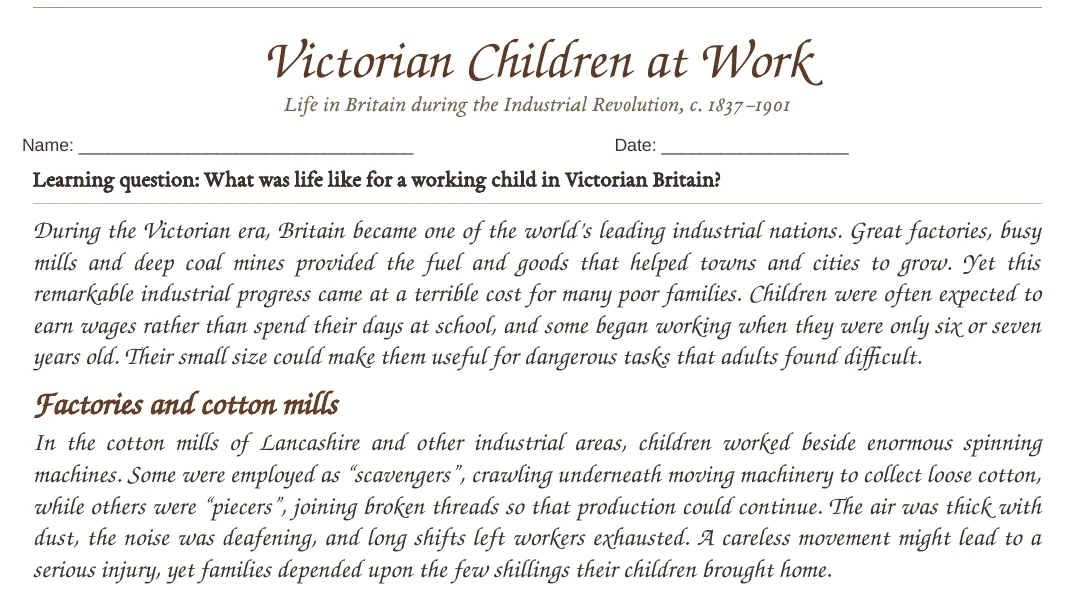
Year 5 · History · as written
Adapted for Wolfgang
Simpler words · larger text
Factories and cotton mills
In the cotton mills, children worked next to big spinning machines. Some were scavengers. They crawled under machines to pick up cotton. Others were piecers. They fixed broken threads so the machines could keep working. The air was full of dust, and it was very loud.
Adapted for Claude
Simplified · purple pages
Factories and Cotton Mills
In cotton mills in places like Lancashire, children worked near huge spinning machines. Some were called "scavengers"; they crawled under machines to pick up loose cotton. Others were "piecers"; they fixed broken threads so the work could continue.
Adapted for George
Original words · blue pages
Factories and cotton mills
In the cotton mills of Lancashire and other industrial areas, children worked beside enormous spinning machines. Some were employed as "scavengers", crawling underneath moving machinery to collect loose cotton, while others were "piecers", joining broken threads so that production could continue.
Adapted for Franz
Adjusted text · more space
Factories and cotton mills
In cotton mills in places like Lancashire, children worked near big spinning machines. Some children were called "scavengers". They crawled under machines to pick up loose cotton. Others were "piecers". They joined broken threads so machines could keep working.
For schools and academy trusts
Planning how to spend your Inclusive Mainstream Fund?
We're enrolling schools and trusts for April 2027, with onboarding, staff CPD and support for your Inclusion Strategy.
- UK GDPRHosted in the UK and encrypted throughout. Your school owns everything it makes.
- WCAG AAAn interface built to WCAG AA, and every pupil's copy formatted for how they read.
- DfE alignedAdaptive teaching for every pupil, as the Teachers' Standards ask.
See OneFitsEach in action
One resource, personalised for every learner
The same worksheet — automatically adapted to each student’s reading level, formatting, and accessibility needs.
Volcanoes
How do volcanoes form and why do they erupt?
Year 5 — Geography

Composite volcano
Volcanic eruptions occur when magma from beneath the Earth's crust rises to the surface. The magma, driven by pressure and gas, forces its way through vents and fissures. Upon reaching the surface it becomes lava, which can flow for kilometres, reshaping the landscape. There are three main types of volcano: shield volcanoes, which have gentle slopes and produce runny lava; composite volcanoes, which are steep-sided and often explosive; and cinder cones, the smallest type, built from fragments of lava blown into the air.
Around 1,500 active volcanoes worldwide. 75% sit in the Ring of Fire.
The word “volcano” comes from Vulcan, the Roman god of fire. The largest volcano in our solar system is Olympus Mons on Mars — nearly three times the height of Everest!
Composite volcano
Volcanic eruptions occur when magma from beneath the Earth’s crust rises to the surface. The magma, driven by pressure and gas, forces its way through vents and fissures. Upon reaching the surface it becomes lava, which can flow for kilometres, reshaping the landscape. There are three main types of volcano: shield volcanoes, which have gentle slopes and produce runny lava; composite volcanoes, which are steep-sided and often explosive; and cinder cones, the smallest type, built from fragments of lava blown into the air.
Teacher tip
Ask pupils to label each type of volcano in their exercise books.
Most of the world’s active volcanoes are found along the Pacific Ring of Fire, a horseshoe-shaped zone stretching 40,000 km around the Pacific Ocean. Volcanoes can also form at hot spots, where plumes of magma rise from deep within the Earth’s mantle. When a volcano erupts explosively, it can send clouds of ash and gas high into the atmosphere, affecting weather patterns across the globe.
Around 1,500 active volcanoes worldwide. 75% sit in the Ring of Fire.
The word “volcano” comes from Vulcan, the Roman god of fire. The largest volcano in our solar system is Olympus Mons on Mars — nearly three times the height of Everest!
When resources match the learner, they’re more willing to start — and more likely to finish.
Try it with your own worksheet
The person who built this still teaches
Danny was diagnosed with dyslexia as an adult, which helped him understand why he had struggled with reading and writing at school. Now, as a primary school teacher and leader of writing in a large school in Leeds, he sees the same fear and difficulties he experienced reflected on the faces of children in his classes. Children struggle to read texts, keep up with peers, stay organised and complete writing tasks. As children move through school, these difficulties continue and the attainment gap widens.
Danny has seen how difficult it is for teachers to provide everything that dyslexic children need to be successful in the classroom due to limited resources and time. Teachers do everything they can, but providing exactly what dyslexic children need feels impossible, and that is before accounting for children who have EAL and other needs.
By creating OneFitsEach, Danny has found a way to easily give children with learning differences exactly what they need, quickly and consistently. In his classroom, self-esteem is up, behaviour difficulties have plummeted and children’s confidence in reading and writing is feeding through into other subjects like maths. Danny is sharing this with other teachers who are seeing the same impact. Children who were quiet, disengaged or completing lower-level work are now included in class discussions and learning.
Four steps to personalised resources
Upload once, adapt for every learner — no more copying, reformatting, or starting from scratch.
Step 1
Upload
Drop a PDF or Word document, import from Google Drive or OneDrive, or snap photos with your phone. OneFitsEach extracts the content automatically.
Step 2
Profile
Set up learner profiles with reading level, font, spacing, and colours. Informed by professional assessments or your own knowledge of each student.
Step 3
Adapt
Hit ‘Adapt & Print’ and OneFitsEach generates a personalised version for every student — each formatted and levelled to their profile.
Step 4
Download a complete set: one PDF per student, formatted for A4, ready to print or share digitally.
Everything you need, nothing you don't
Purpose-built for educators who support learners with additional needs — every feature designed to save time and increase access.
Resource Generators
A gallery of teacher-designed generators — comprehension, vocabulary, cloze, and more — each producing fully formatted, print-ready documents tailored to your topic and year group.
Learn moreAccessibility Profiles
Set reading level, font, spacing, and colours for each learner. Profiles drive automatic adaptations across every resource.
Learn moreLearning Packs
Select your classes, pick a date, and generate adapted resources for every pupil in one click. Each learner gets resources at their level.
Learn moreCamera Capture
Photograph a printed resource with your phone. OneFitsEach extracts the content and makes it adaptable — no scanning required.
Learn moreWhat teachers say about OneFitsEach
OneFitsEach has transformed provision in our school!
Dani Thurlow
Associate SENCO, Moor Allerton Hall Primary School
Simple, teacher-friendly pricing
Start free. Upgrade when you're ready.
Starter
For individual teachers getting started.
Free
- 30 document outputs a month
- 3 student profiles
- All resource generators
- Google Drive & OneDrive import
Classroom
For teachers managing a full classroom.
From £8/mo
- 400 document outputs a month
- Unlimited student profiles
- Up to 3 classes & learning packs
- Priority support
School
For schools rolling out across departments.
Per pupil
- Everything in Classroom
- School-wide dashboard
- Shared student profiles
- Onboarding & training
Start personalising resources today
Join educators across the UK who are saving hours every week — while helping every learner feel confident through adaptive teaching.